
Humane Feeder Troubleshooting
How to Keep Squirrels Away From a Bird Feeder Without Harmful Tricks
Inspect climbing and jumping routes, compare compatible baffles and weight-sensitive feeders, and skip grease, traps and improvised deterrents.
By Pussies & Tits · 5 min read · Published
Sourcing and editorial standardsThe short answer
Start by removing easy jumping routes and use a correctly installed, compatible baffle or a feeder designed to restrict squirrel access. Cornell notes that complete exclusion is difficult. Do not use poison, sticky substances, grease or harmful traps to protect birdseed.
See your next step →Key takeaways
- A baffle helps only when squirrels cannot bypass it from nearby structures.
- Check pole diameter, mounting and feeder compatibility before buying.
- Reduced raiding is a realistic aim; 'squirrel-proof' is not a guarantee.
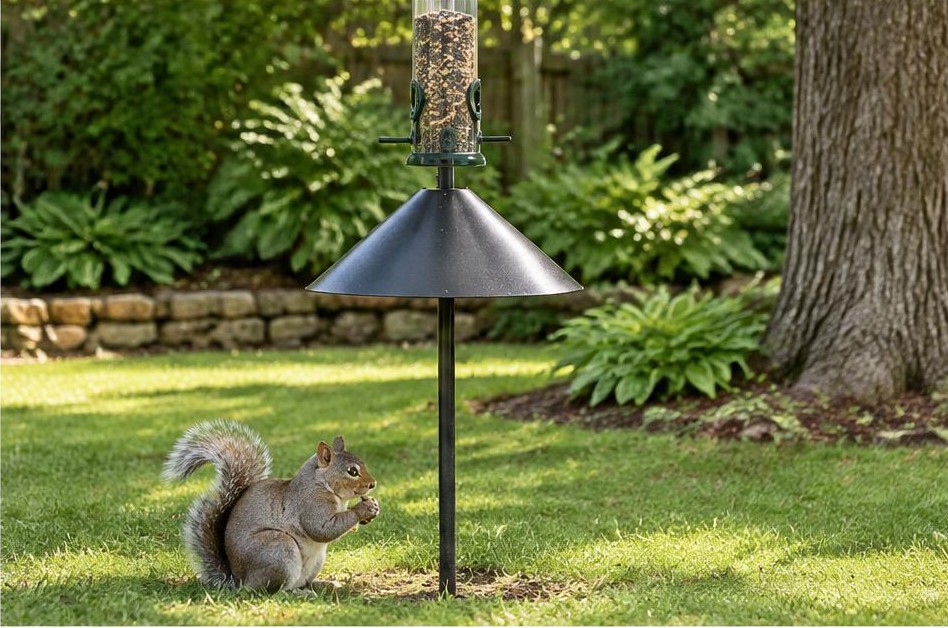
Watch how the squirrel reaches the seed
Cornell describes placement and feeder design as practical approaches while warning that completely excluding squirrels is difficult. Observe from a distance before ordering equipment. Does the animal climb the support, jump from a fence or descend from an overhead branch? A pole baffle addresses a climbing route but cannot block a jump directly onto the feeder. Record the actual route rather than guessing from the last place the squirrel was seen.
Choose the intervention that matches the route
Baffles, relocation and weight-sensitive mechanisms solve different problems. Manufacturer installation requirements determine compatibility; do not copy an arbitrary height or clearance from an unrelated product. Check whether the pole is stable and whether the feeder can still be reached for cleaning.
| Route | Possible response | Check before buying |
|---|---|---|
| Climbs the pole | Compatible pole baffle | Pole diameter and mounting instructions |
| Jumps from a fence | Relocate the station | Other nearby launch points |
| Descends from a branch | Change support or position | Overhead access |
| Reaches feeding ports | Suitable exclusion design | Operation and intended bird access |
Match a baffle to the support you already have
Check your pole diameter and the full installation instructions before comparing squirrel-resistant designs.
Compare on Amazon →Affiliate link: we may earn from qualifying purchases at no extra cost to you.
Keep deterrence humane and uncomplicated
Avoid methods that can foul fur or feathers, injure animals or contaminate food. Do not coat the pole in grease, use glue or set harmful traps. This guide does not recommend homemade pepper treatments, chemicals or medication in bird food. Physical design and site changes are easier to inspect and maintain than improvised substances. The aim is to manage access to one food source, not to remove wildlife from the neighborhood.
Evaluate a weight-sensitive feeder honestly
Read how the mechanism is adjusted and what prevents it jamming. Look for removable parts and access to trapped debris. Claims about which animals or birds are excluded depend on the model and setup; we have not tested them. Observe after installation to see whether intended birds can feed and whether squirrels find another route. If the feeder becomes difficult to clean, that drawback matters even when the mechanism reduces seed loss.
Reduce waste and accept the limits
Use appropriate quantities, clear fallen food and store seed securely. Feeding squirrels separately is sometimes suggested, but it can also attract more animals and is not necessary for this plan. Follow local advice on rodents, bears and wildlife feeding before adding another food source. If the yard offers unavoidable jumping routes, change the location or reduce feeding rather than escalating deterrents. Native habitat and birdwatching remain worthwhile without a perfectly defended feeder.
Frequently asked questions
Will a baffle make every feeder squirrel-proof?
No. It must fit and be installed correctly, and squirrels may bypass it from branches or structures.
Should I grease a feeder pole?
No. Avoid substances that may harm or foul wildlife. Use suitable physical equipment and improve placement instead.
Sources and further reading
This guide summarizes the references below. It is not a veterinary consultation or an independently tested product review. Check current local wildlife advice before acting.
Match a baffle to the support you already have
Check your pole diameter and the full installation instructions before comparing squirrel-resistant designs.
Compare on Amazon →Affiliate link: we may earn from qualifying purchases at no extra cost to you.
Keep exploring
North American Bird Feeding
How to Attract Birds to a New Feeder: Check Food, Habitat and Safety First
A North American troubleshooting plan for a quiet feeder, without promising a deadline or recommending food piles on the ground.
5 min read
Cool-Weather Feeding
Where to Hang a Suet Feeder: Check Cats, Glass, Heat and Cleaning Access
Choose a secure cool-weather location and an inspectable cage for North American chickadees, titmice and other suet visitors.
5 min read