
Safer Feeder Placement
Bird Feeder Placement Near Cats and Windows: A Small-Garden Checklist
Assess ambush cover, cat access, hazardous glass and maintenance together rather than treating one distance as a guarantee of safety.
By Pussies & Tits · 6 min read · Published
Sourcing and editorial standardsThe short answer
Choose a feeder location with clear sight lines, no easy cat launch points and a plan for nearby glass. Cornell recommends feeders closer than 3 feet to picture windows to reduce potential collision speed, but glass still needs suitable treatment. Keep cats indoors and do not install a feeder where birds remain within reach.
See your next step →Key takeaways
- Escape cover for birds can also conceal cats; inspect the real layout.
- Feeder distance alone does not prevent window collisions.
- An unsafe site is a reason not to install a feeder, not a reason to buy a taller one.
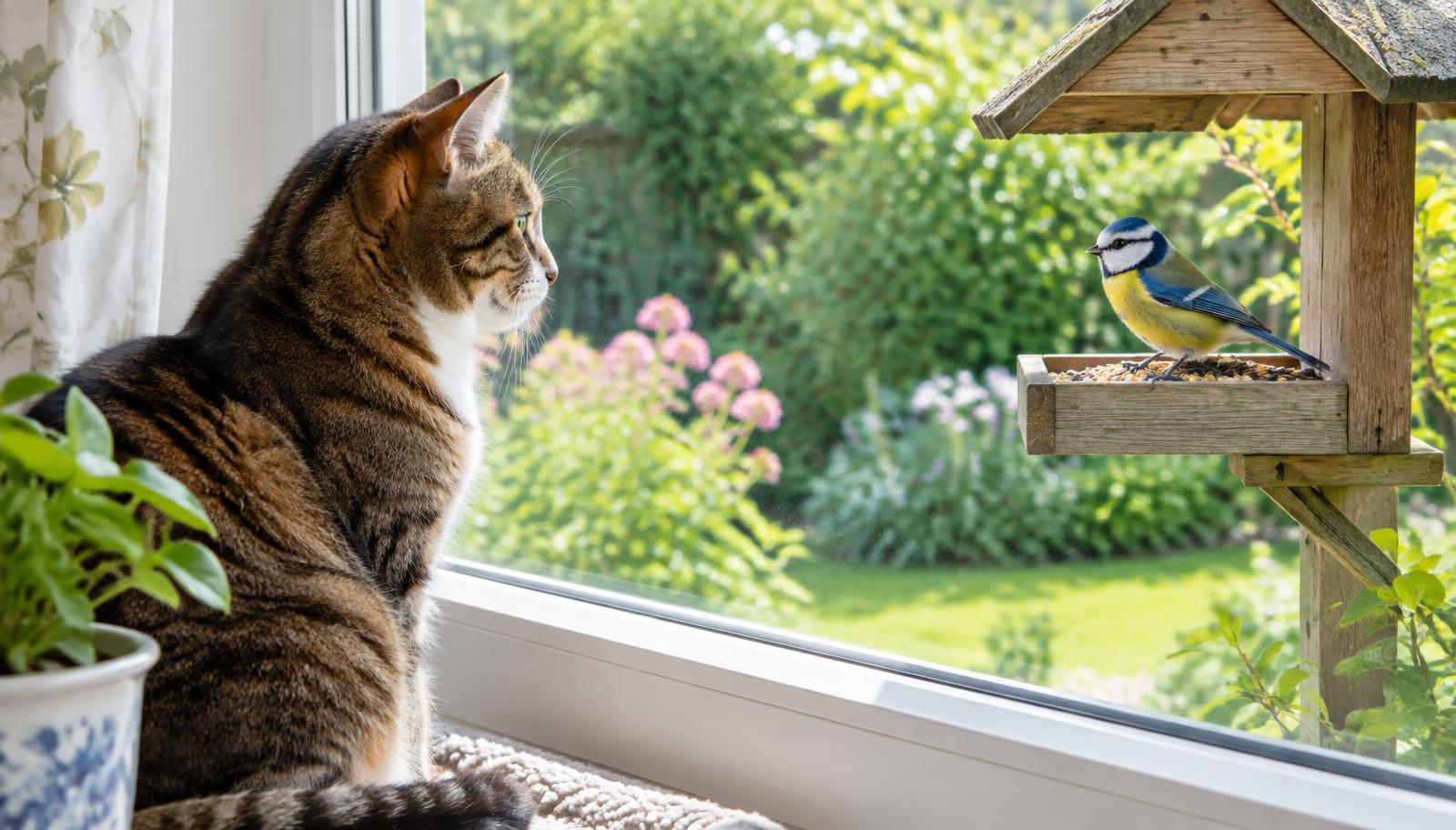
Assess the cat’s route before the bird’s view
Stand at the proposed position and look for fences, furniture, low branches and walls that could provide a launch point. Check beneath shrubs for concealed approaches. Cats Protection advises avoiding locations where cats can hide and stalk, and discourages feeding wildlife on the ground. Keeping your own cat indoors reduces one source of risk but does not remove visits from other cats. A clear, observable setting is a better starting point than a feeder hidden in dense low cover.
Treat the window as a separate hazard
Cornell’s feeder-placement guidance recommends putting feeders closer than 3 feet to a picture window to reduce impact speed if a bird flies toward the glass. That is risk reduction, not proof the window is safe. Reflections and apparent through-routes remain hazards. Consult bird-collision guidance about suitable dense exterior markings or other effective treatments. A single decorative silhouette does not adequately treat a whole large pane.
Choose feeder equipment only after the site check
If you can separate cats, treat glass and maintain hygiene, compare suitable poles and easy-clean feeders.
Compare on Amazon →Affiliate link: we may earn from qualifying purchases at no extra cost to you.
Use a layout checklist before ordering a pole
Consider cats, glass, cover and cleaning access together. A feeder that is awkward to reach may be neglected; one beside a convenient wall may also be easy for a cat to access. There is no single measurement that guarantees safety in every garden.
| Check | Look for | Next step |
|---|---|---|
| Cat access | Launch points and ambush cover | Relocate or do not feed here |
| Glass | Reflections and clear flight routes | Treat hazardous exterior glass |
| Bird movement | Visible approaches and escape options | Avoid concealed ground-level feeding |
| Maintenance | Safe access and fallen food | Choose a site you can clean |
A balcony needs a stricter decision
If a cat uses the balcony, a bird’s arrival can trigger a pounce or a fall. The Cat Protection Society of NSW emphasizes that previous uneventful access does not remove that risk. Do not fit a feeder within reach or rely on supervision alone. Only consider a setup with suitable secure separation and permission for any enclosure work. If separation cannot be achieved, skip the feeder and provide indoor enrichment away from open edges.
Keep location connected to hygiene and season
Once a position is selected, plan how you will remove fallen food and disassemble the feeder for cleaning. Adjust food quantities to actual visits. In the UK, current RSPB guidance advises pausing seeds and peanuts from May 1 to October 31; recheck the source before feeding and follow local advice elsewhere. A safer location does not override disease concerns or make inappropriate food appropriate.
What to compare if the site passes the checks
Choose a stable support and feeder suited to the installation, with documented fixing instructions and cleanable parts. Compare exterior glass-treatment systems using conservation guidance rather than decorative appeal. We have not independently tested poles or window products. Observe the site after installation, and stop feeding or revise it if cats stalk there, collisions occur or hygiene becomes difficult. Not feeding at an unsafe location is a responsible outcome.
Frequently asked questions
Does a high feeder keep birds safe from cats?
Not necessarily. Fences, branches and other launch points can make an elevated feeder accessible. Assess the entire site and keep pets separated.
Is a window sticker enough to prevent collisions?
A single decorative sticker is not a sufficient whole-window treatment. Follow specialist guidance on effective dense exterior patterns and coverage.
Sources and further reading
This guide summarizes the references below. It is not a veterinary consultation or an independently tested product review. Check current local wildlife advice before acting.
Choose feeder equipment only after the site check
If you can separate cats, treat glass and maintain hygiene, compare suitable poles and easy-clean feeders.
Compare on Amazon →Affiliate link: we may earn from qualifying purchases at no extra cost to you.
Keep exploring
Indoor Enrichment
Cat Window Perch Without Suction Cups: A Fit-First Buying Guide
Compare sill-mounted, clamp-on and freestanding options without guessing whether they fit your window or support your cat.
6 min read
Feeder Hygiene
How to Clean Bird Feeders: A Trichomonosis-Aware Hygiene Checklist
Separate routine cleaning from illness response, prevent cross-contamination and choose equipment you can actually disassemble.
6 min read
Cats & Wildlife
How to Keep Your Cat From Catching Garden Birds
Practical, humane steps that let pet cats and backyard songbirds live side by side.
8 min read